




- NYCU College of Nursing Expands Global Footprint with High-Level Exchanges from the U.S., Australia, and the Philippines
- NYCU Partners with Siemens Taiwan and Mega Flow to Build AI-Driven Engineering Simulation Platform
- Taiwan’s First Homegrown Satellite “FS-8A” Reaches Orbit — NYCU Highlights the Power of Talent Behind the Nation’s Space Ambitions
- NYCU Prof. Yu-Chung Tseng Wins First Prize at Musica Nova 2025
- NYCU and Nobel Laureate Unveil Breakthrough Algorithm to Accelerate Protein Structure Search and Drug Discovery
NYCU and TVGH Announce New Asian Guidelines Lowering Sarcopenia Screening Age to 50
(中央社訊息服務20251211 10:44:50)Nearly 40% of older adults in Asia face compromised quality of life due to sarcopenia, a progressive loss of muscle strength and mass. Now, a landmark multi-nation study has revealed that muscle deterioration in Asian populations begins far earlier than previously believed—prompting experts to recommend moving routine screening from age 65 to 50. The new consensus, led by Professor Liang-Kung Chen, Superintendent of Taipei City Guandu Hospital and Director of the Center for Healthy Longevity and Aging Sciences at National Yang Ming Chiao Tung University (NYCU), was published this year in the prestigious journal Nature Aging.
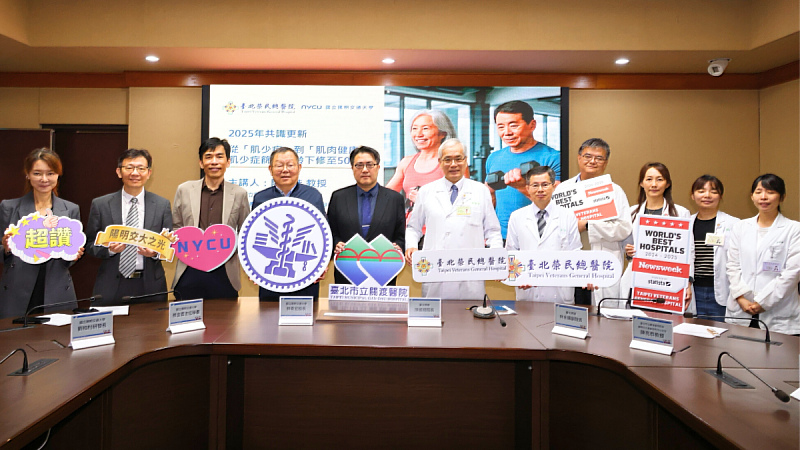
At a press briefing, Director Chen explained that the findings are based on eight large-scale cohort studies across Japan, Korea, Singapore, Thailand, Hong Kong, and other regions, tracking nearly 35,000 individuals over many years. The Asian Working Group for Sarcopenia integrated these datasets to build a region-specific evidence base that reflects the unique body composition and aging patterns of Asian populations.
Skeletal muscle loss has long been known as a hallmark of aging. Past global studies estimated that adults lose up to 40% of muscle mass between ages 20 and 70, with an annual decline of 1.4–2.5% after age 60. But the new Asia-focused analysis reveals significant differences:
。Muscle strength declines sharply beginning at age 45, with a second major dip around age 70.
。Muscle mass begins to decline significantly at age 55, about a decade earlier than Western-based assumptions suggest.
。Men experience a more pronounced midlife decline compared with men of African or European descent; women begin with lower muscle mass but experience a slower rate of decline.
。Stronger midlife muscle performance can delay deterioration by up to 10 years—for instance, men with handgrip strength of 55 kg or above at age 50 show substantially slower decline.
These patterns confirm that Western diagnostic thresholds are poorly suited for Asian populations and that early detection is essential.

Director Chen emphasized that waiting for both muscle strength and mass to “fall off a cliff” before intervening leads to limited gains, greater frustration, and poorer patient outcomes. The updated Asian diagnostic consensus introduces several significant changes:
。Recommended screening age lowered from 65 to 50.
。Diagnosis now requires both low muscle mass and low muscle strength, replacing older criteria that relied heavily on physical performance tests.
。Simplified assessment procedures, reducing the need for walking-speed or repeated chair-stand tests.
。Integration with the WHO’s Integrated Care for Older People (ICOPE) framework, aligning Asia with global healthy-aging strategies.
Recent scientific advances have shown that skeletal muscle functions as the body’s largest endocrine organ, influencing cardiovascular metabolism, brain function, bone health, adipose regulation, and immune responses. With these broader systemic links in mind, the new consensus emphasizes “muscle health enhancement” beginning in midlife—not only to prevent disability and frailty in later years but also to promote long-term healthy longevity.

As Asia rapidly transitions into a super-aged society, the updated guidelines offer a unified scientific roadmap to help governments, hospitals, and communities strengthen early intervention, develop preventive programs, and support healthy aging from midlife onward.