




- NYCU and Nobel Laureate Unveil Breakthrough Algorithm to Accelerate Protein Structure Search and Drug Discovery
- NYCU’s Tech-Art Innovation Takes Center Stage Across Europe and Asia
- NYCU College of Management Wins 2025 WRDS Innovation Award
- From Rising Rankings to Global Presence: NYCU’s First Showcase at the QS Asia-Pacific Summit Exhibition
- NYCU and NCSIST Forge Strategic Alliance to Advance Taiwan’s Defense Technology Independence
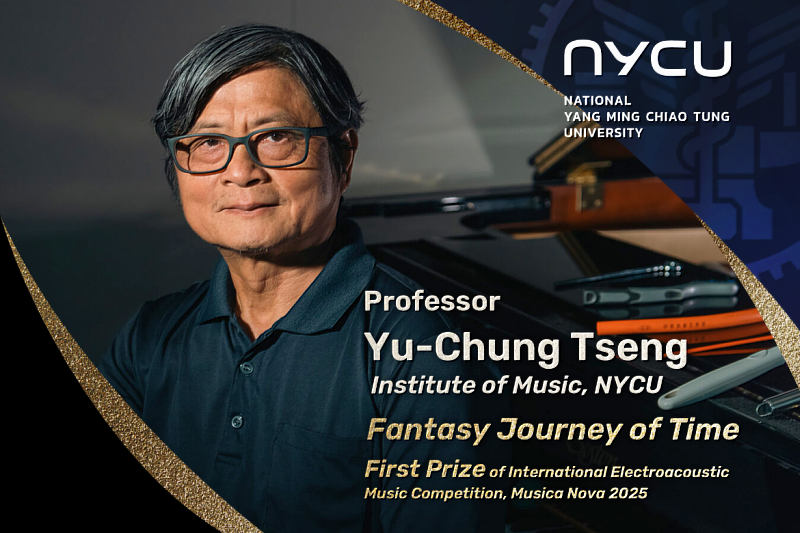
NYCU Prof. Yu-Chung Tseng Wins First Prize at Musica Nova 2025
(中央社訊息服務20251202 15:43:36)National Yang Ming Chiao Tung University (NYCU) Professor Yu-Chung Tseng from the Institute of Music has won First Prize in the Instrument and Electronics category at the highly competitive Musica Nova 2025 International Electroacoustic Music Competition in Prague. His award-winning work, “Fantasy Journey of Time,” impressed judges with its fusion of Eastern aesthetics, advanced digital sound design, and cutting-edge AI-generated musical elements.
Musica Nova—jointly organized by the Czech Electroacoustic Music Society, the Czech Music Council, the Arts and Theatre Institute, the Music Information Centre, and Czech Radio, with sponsorship from the Czech Ministry of Culture and the Czech Music Foundation—is regarded as one of the world’s most prestigious competitions for contemporary electronic and electroacoustic music. The contest is divided into two categories: Electroacoustic Music and Instrument & Electronics.
This year’s competition drew 94 composers from 24 countries, making the selection process especially rigorous. Professor Tseng’s work stood out among the international submissions, securing the top honor in the Instrument and Electronics category.
“Fantasy Journey of Time” is composed for solo flute and electronic soundscape. Professor Tseng explains that the work employs extensive DSP (digital signal processing) techniques, including granular synthesis, to transform sampled flute sounds into highly abstract timbral textures—often indistinguishable from their acoustic origin. This approach creates a sense of suspended expectation, drawing listeners into a constantly shifting sonic world.
Incorporating the latest technological trends, Tseng also used artificial intelligence to generate part of the flute melodies. Throughout the piece, the human performer and AI-generated flute lines collide, intertwine, and merge—an evolving “co-creation” between musician and machine.
“The acoustic flute and its AI-derived abstractions continuously collide and blend,” Tseng noted. “It becomes a dialogue between the performer and the algorithm, the human mind and computer intelligence.”
Beyond technological innovation, the composition reflects Professor Tseng’s long-standing artistic interest in Eastern philosophy, particularly the interplay of yin and yang, and the dialectics of presence and emptiness.
In the unfolding of musical time, Tseng hopes listeners feel as if they are “traveling aboard a temporal train or spacecraft—journeying freely through a galaxy of ever-changing sounds.” The work invites audiences to immerse themselves in a vivid spectrum of musical colors and sonic imagination.