




- NYCU Students Win Global Championship at JAXA’s Kibo-RPC Space Robotics Programming Challenge
- NYCU and MUFG Convene Taiwan–Japan–India Semiconductor Conference to Strengthen Regional Value Chains
- NYCU to Install Taiwan’s First Human 7-Tesla MRI, Opening a New Era for Brain Science Research
- NYCU Team Develops High-Efficiency Distributed Propulsion VTOL UAV
- NYCU Partners with Stanford and Leading U.S. Universities to Send Students into Silicon Valley Labs
NYCU Launches Digital “Introduction to Chinese Medicine” Course for High School Students Across Taiwan
(中央社訊息服務20260312 15:50:36)High school students in Taiwan will soon have the opportunity to study the foundations of traditional Chinese medicine through a new digital course developed by National Yang Ming Chiao Tung University (NYCU).
The course, titled “Introduction to Chinese Medicine,” has been created as a flexible elective resource for high schools nationwide. By introducing core concepts of traditional medicine at an earlier stage of education, the initiative aims to promote accurate public understanding of Chinese medicine while strengthening medical education at the pre-university level.
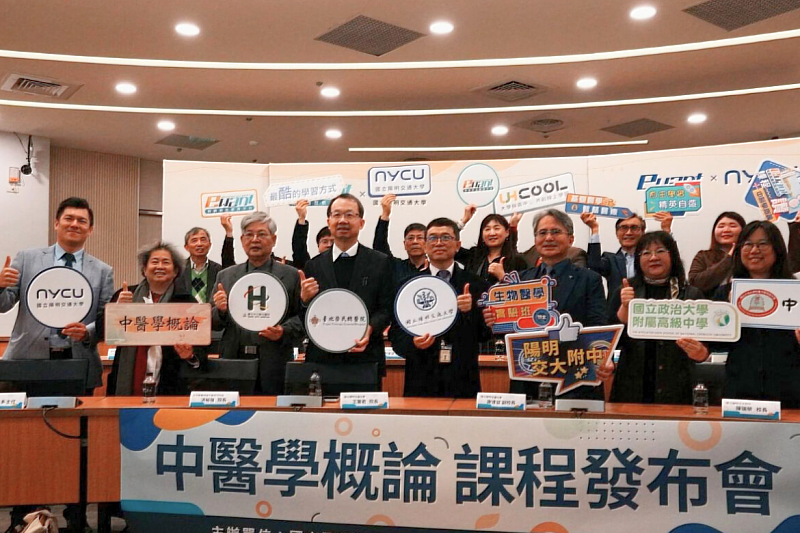
The curriculum was jointly designed by NYCU’s Department of Chinese Medicine, Taipei Veterans General Hospital, and Taipei City Hospital. It will first be offered to affiliated high schools within the University System of Taiwan, including NYCU Affiliated Senior High School, National Chengchi University Affiliated High School, and National Central University’s Chungli Senior High School.
Beginning in the 2026 academic year, the course will also be made available nationwide through ewant, Taiwan’s open online education platform, allowing high school students across the country to enroll.
The launch follows NYCU’s earlier release of the “Introduction to Medicine” course last year and reflects a broader effort to promote medical knowledge as part of public scientific literacy under Taiwan’s “Healthy Taiwan” vision.
Hung Yu-Chiang, director of the Linsen Chinese Medicine and Kunming Branch of Taipei City Hospital, said the course introduces students to the foundations of Chinese medical theory, diagnostic approaches, and modern applications.
“We hope that when students first encounter Chinese medicine, they can understand both its cultural context and its scientific methods,” Hung said. “This helps them develop a more integrated perspective on health, disease, and medical decision-making.”
Chen Fang-Pey, chair of NYCU’s Department of Chinese Medicine, expressed appreciation for feedback from teachers at Taipei Municipal Chenggong High School and NYCU Affiliated Senior High School in fields including biology, Chinese language, and health education.
Their input, Chen said, helped refine the course so that it breaks away from the stereotype that Chinese medicine is difficult or inaccessible, while inspiring students to explore the field of traditional medicine and broader medical disciplines.
NYCU Vice President Hsieh Dar-Bin noted that the initiative is part of the university’s University–High School Collaboration on Online Learning (UHCOOL) program, which promotes co-developed digital courses for high school education.
Through UHCOOL, NYCU has gradually introduced online courses on semiconductors, emerging technologies, and medicine, helping expand elective learning opportunities for high schools across Taiwan.
“Science and medical education should not be limited to certain regions or institutions,” Hsieh said. “By opening these courses online, we hope more students can encounter these fields at a critical stage of exploring their future paths, discover their interests, and envision new possibilities.”