




- NYCU Patents Smart Surface Technology to Eliminate Signal Dead Zones
- NYCU Publishes PlayChip, Bringing Taiwan’s AI-Semiconductor Education Model to the World
- Top Scholars from Taiwan, the U.S., and Korea Gather at NYCU to Advance Cancer Immunology Research
- NYCU AI Team Ranks Among Top Five Worldwide in CVPR 2026 Deepfake Detection Challenge
- NYCU Uses AI and Semiconductor Education to Support Ukrainian Students Reimagine the Future
NYCU Student Team Reaches Finals at Singapore Autonomous Underwater Vehicle Challenge
(中央社訊息服務20260611 10:41:27)A student team from National Yang Ming Chiao Tung University (NYCU) has advanced to the finals of the 2026 Singapore Autonomous Underwater Vehicle Challenge (SAUVC), one of Asia’s leading competitions for autonomous underwater robotics.
Competing as Taiwan’s only representative team this year, NYCU’s ORCA AUV Team successfully progressed through the qualification round. It earned a place in the finals alongside top university teams from around the world. Although the team did not finish among the top three, the competition provided a valuable opportunity to validate the performance of its autonomous underwater vehicle (AUV) system, particularly in autonomous navigation, underwater sensing, and integrated decision-making capabilities.
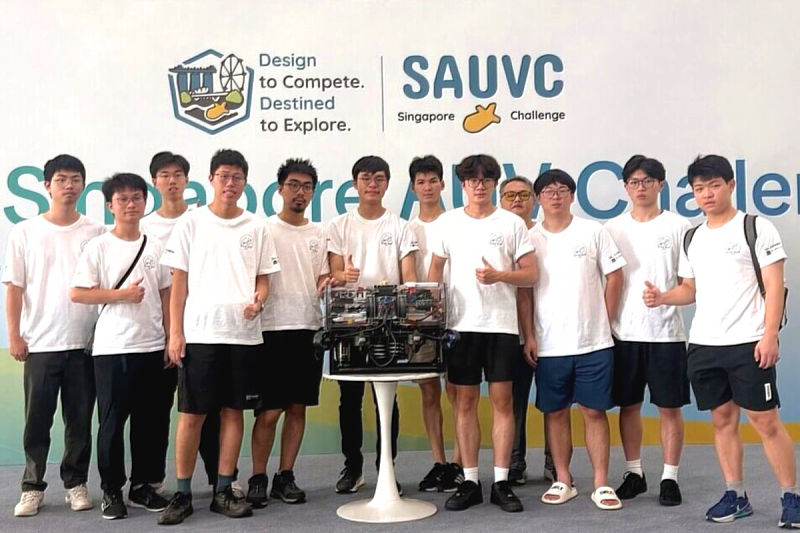
The SAUVC competition consists of two major stages: a qualification round and a final round.
In the qualification stage, autonomous underwater vehicles must independently navigate through a designated gate, execute a turn, and pass through the gate again without any human intervention. Finalists then face a series of advanced missions, including underwater navigation, underwater communication, object retrieval, and object deployment tasks. All operations must be completed autonomously, placing significant demands on a team’s perception, control, and decision-making systems.
The competition is widely regarded as a rigorous test of underwater robotics technologies and system integration capabilities.
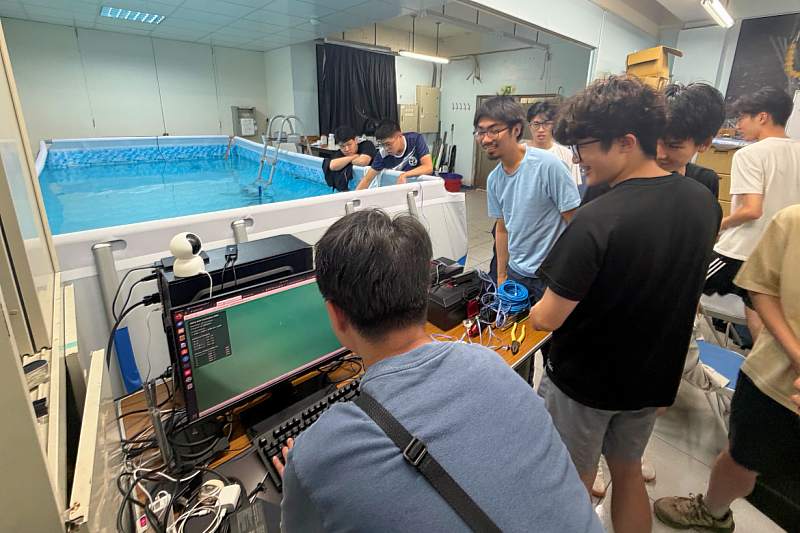
The ORCA AUV Team is jointly advised by NYCU professors Kim Boon Lua and Chia-Hung Tsai from the Department of Mechanical Engineering. The team brings together 12 students from the Departments of Mechanical Engineering and Electronics and Electrical Engineering.
Combining computer vision, automatic control, and propulsion technologies, the students developed an autonomous underwater vehicle capable of making navigation and operational decisions in dynamic underwater environments.
According to Professor Lua, the primary goal of the competition is to encourage students to enter the field of marine robotics and to advance autonomous technologies for applications such as ocean exploration, underwater inspection, subsea operations, and search-and-rescue missions.
“Competitions like SAUVC emphasize both autonomy and system integration,” Lua said. “Completing these tasks requires teams to integrate multiple engineering disciplines into a reliable and intelligent system, making it an extremely challenging but rewarding learning experience.”
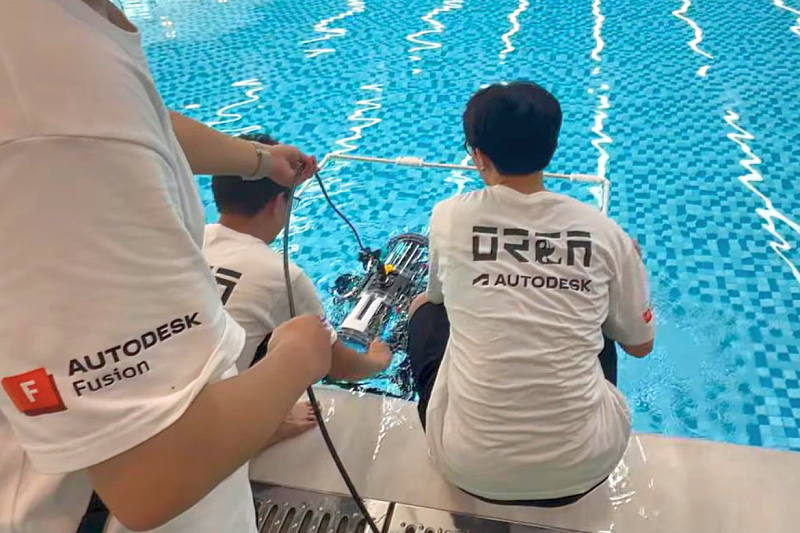
For the student team, the road to the competition was filled with technical obstacles. Team member Po-Shao Wu recalled that the group encountered numerous challenges during development and testing, including water leakage, failures in visual recognition systems, and insufficient localization accuracy. Through repeated testing, troubleshooting, and teamwork, the students gradually resolved these issues and improved system reliability.
“This year, many new members joined the team and were still learning how the system worked,” Wu said. “Despite the steep learning curve, everyone devoted a tremendous amount of time and effort. In the end, we completed the development, testing, and competition missions together.”
While the team narrowly missed a podium finish, its successful qualification for the finals demonstrated the growing capabilities of NYCU students in autonomous marine robotics. It highlighted the university’s commitment to hands-on engineering education and interdisciplinary innovation.