




- Taiwan–U.S. Biomedical Collaboration: NYCU and NHRI Co-host with UC Irvine to Advance Big Data in Tumor Biology and Immunology
- NYCU Marks 5th Anniversary with Opening Ceremony at Bo-Ai Campus, Showcasing Renewal and Future Vision
- NYCU Hosts GCIEM Summit as Global Experts and Industry Converge on Engineering Medicine and AI
- NYCU Awards Honorary Doctorate to Renowned Photonics Scientist Jia-Ming Liu
- NYCU Professors Honored with Prestigious Awards for Breakthroughs in Brain and Liver Research
NYCU Develops Humidity-Resistant Catalyst to Tackle Ozone Pollution in Subtropical Climates
(中央社訊息服務20260422 16:24:25)Spring and autumn mark peak ozone seasons in Taiwan, when prolonged exposure to elevated ozone levels is linked to increased risks of respiratory and cardiovascular diseases. Yet many conventional ozone-decomposing catalysts lose effectiveness in humid environments—a critical limitation in subtropical regions.
Now, a research team led by Professor Kuo-Pin Yu at National Yang Ming Chiao Tung University (NYCU) has developed a novel humidity-resistant catalyst capable of efficiently breaking down ozone even under high-moisture conditions, offering a promising solution tailored to Taiwan’s climate.
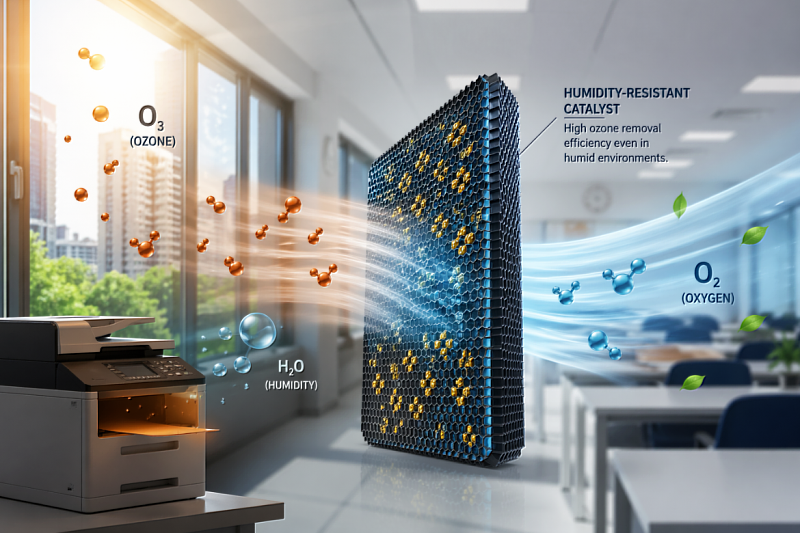
Ozone is often associated with the protective layer in the upper atmosphere. At ground level, however, it is a harmful secondary pollutant formed when emissions react under sunlight. As daylight hours lengthen in spring and ultraviolet radiation intensifies, photochemical reactions accelerate ozone formation.
These ozone molecules can infiltrate indoor spaces through air circulation. In addition, modern office equipment such as laser printers can act as unexpected indoor sources of ozone, further elevating exposure risks.
According to the World Health Organization, the recommended maximum for an eight-hour average ozone concentration is 100 micrograms per cubic meter. However, indoor environments such as offices and classrooms frequently exceed this threshold.
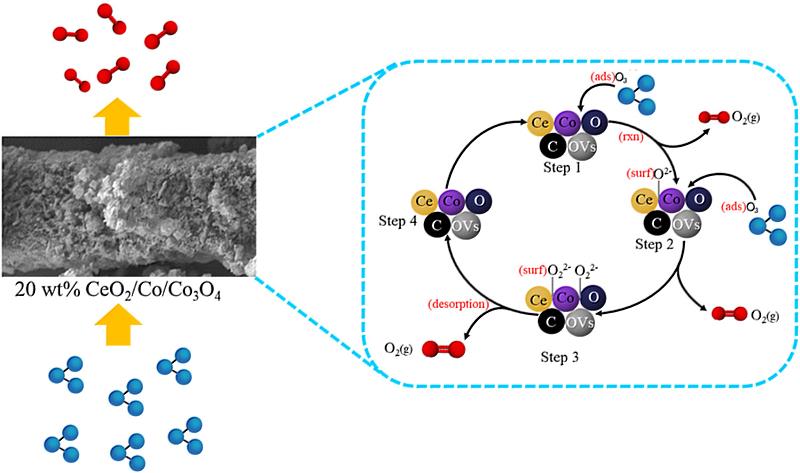
Among existing ozone mitigation strategies, catalytic decomposition is considered one of the most effective. However, moisture has long been a major obstacle, as water molecules tend to occupy active sites on catalysts, significantly reducing their efficiency.
To address this challenge, Professor Yu’s team turned to metal-organic frameworks (MOFs)—nanoporous crystalline materials composed of metal clusters and organic linkers. Known for their exceptionally high surface area, tunable pore sizes, and versatile chemical properties, MOFs have attracted global attention for applications ranging from energy storage and gas separation to catalysis and water desalination.
The team employed an advanced “MOF-on-MOF” strategy, assembling two distinct MOF structures like building blocks and coating the composite with a protective carbon layer. This design allows electrons to move efficiently within the material while preventing water molecules from occupying active catalytic sites.
Experimental results show that the new catalyst achieves a 99% ozone removal rate at room temperature and 50% relative humidity. Even under 75% humidity, it maintains an impressive 92% efficiency.
Professor Yu likened the innovation to “wearing a water-repellent jacket,” explaining that the carbon coating shields the catalyst from moisture while also enhancing electrical conductivity, which facilitates the activation of oxygen molecules. This dual function enables stable ozone decomposition even in Taiwan’s hot and humid environment.
Looking ahead, the research team envisions broad applications for the technology. Potential uses include integration into air purifiers, deployment in hospitals, schools, and public transportation systems, and incorporation into building ventilation and filtration systems.
By bridging advanced materials science with real-world environmental challenges, the breakthrough underscores NYCU’s role in developing practical solutions for healthier living environments in a changing climate.