




- NYCU Partners with GWOXI and PODAK to Advance Automated Stem Cell Manufacturing Platform
- NYCU Study Redefines Battery Design, Boosting Capacity by 167% for Next-Generation EVs
- NYCU Honors Six Distinguished Alumni in Student-Led Ceremony Showcasing Cross-Sector Innovation
- NYCU Partners with HHRI and RPI to Develop High-Speed Micro-LED Quantum Random Number Generator
- NYCU Showcases Architectural Futures, Rethinking Urban Resilience and Design
NYCU Builds One of Taiwan’s Most Complete Virtual Campuses in Minecraft
(中央社訊息服務20260401 09:58:56)As National Yang Ming Chiao Tung University (NYCU) marks its fifth anniversary—alongside the 130-year legacy of National Chiao Tung University (NCTU)—a new kind of campus is taking shape, not in concrete and steel, but in pixels and code.
A student-initiated project, supported by the NCTU Alumni Association, is recreating NYCU’s campuses inside the global sandbox game Minecraft. More than a digital replica, the initiative is designed to connect alumni across generations and geographies—inviting them to “return” to campus from anywhere in the world.
Launched in 2025, the project is led by a student team in collaboration with DreamCity Studio. Starting with the historic Bo-Ai Campus, the team reconstructed buildings to real-world dimensions while integrating future development plans—allowing past, present, and future to coexist in a single virtual environment.
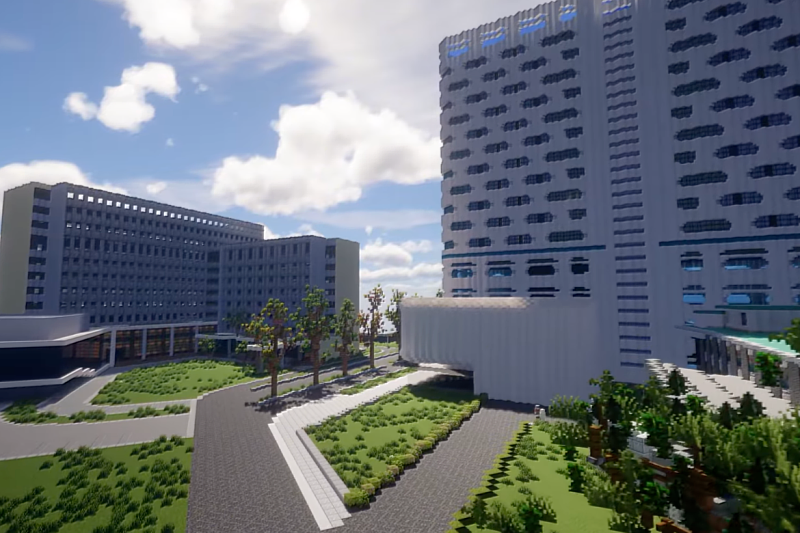
Unlike conventional digital archives or static 3D models, the NYCU Minecraft campus is built as a living narrative.
Visitors can revisit familiar landmarks from decades past, walk through the university as it stands today, and glimpse what lies ahead. Planned transformations—such as the redevelopment of student dormitories and the future construction of facilities including the Chuming Hospital—are embedded directly into the virtual landscape.
This layered design turns the project into more than a reconstruction. It becomes a storytelling platform—one that reflects NYCU’s evolution from NCTU’s 130-year legacy to its identity as a five-year-old merged institution.
While Minecraft has been used in Taiwan for educational and creative purposes—including classroom teaching in geography, architecture and history—most campus-related projects remain limited in scope.
Many are small-scale efforts focused on individual buildings or partial areas. Others are personal or club-based creations that remain unpublished, lacking long-term planning or public engagement. NYCU’s project stands apart.
It delivers a full reconstruction of both the Bo-Ai and Guang-Fu campuses, making it one of the most complete virtual campus builds in Taiwan to date. More importantly, it operates as an organized initiative rather than a standalone creation—bringing together students, a professional creative studio, and alumni support under a unified vision.
The project also integrates outreach strategies, including promotional videos, guided experiences and interactive participation mechanisms, transforming it from a static model into a dynamic, externally shareable platform.
In this sense, NYCU’s Minecraft campus is not simply a digital experiment—it represents a first-tier, flagship case that can be presented internationally.
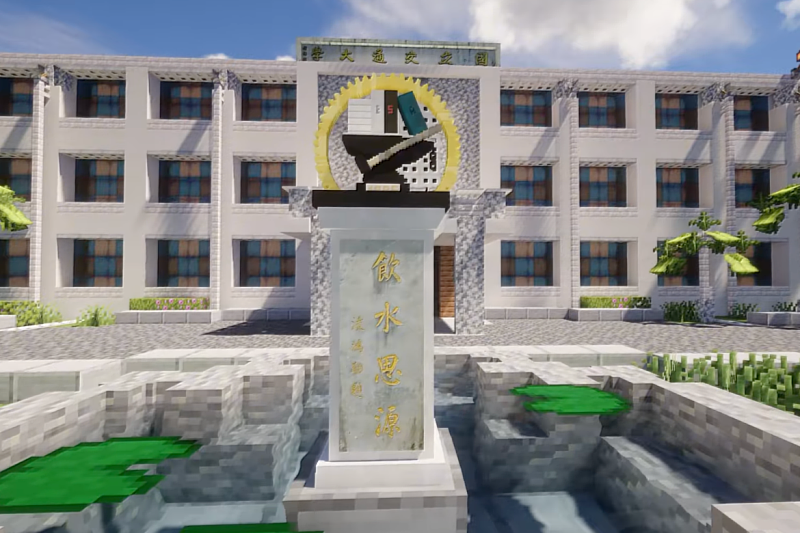
At its core, the initiative is about reconnection. By embedding memory, identity and future vision into a shared virtual space, NYCU is redefining how universities engage their global communities. Alumni are no longer limited to nostalgic recollection—they can actively explore, interact and rediscover the campus in an evolving digital form.
The project reflects a broader shift in higher education, where digital environments are increasingly used not just for teaching, but for storytelling, community-building and institutional identity.
The virtual Bo-Ai and Guang-Fu campuses have now been completed and are scheduled to open for online exploration in early April.
For NYCU’s global alumni network, the experience offers something both familiar and new: a chance to walk the same paths, see the campus transformed, and imagine what comes next. In a single, block-built world, 130 years of history—and the future still unfolding—are brought into view.